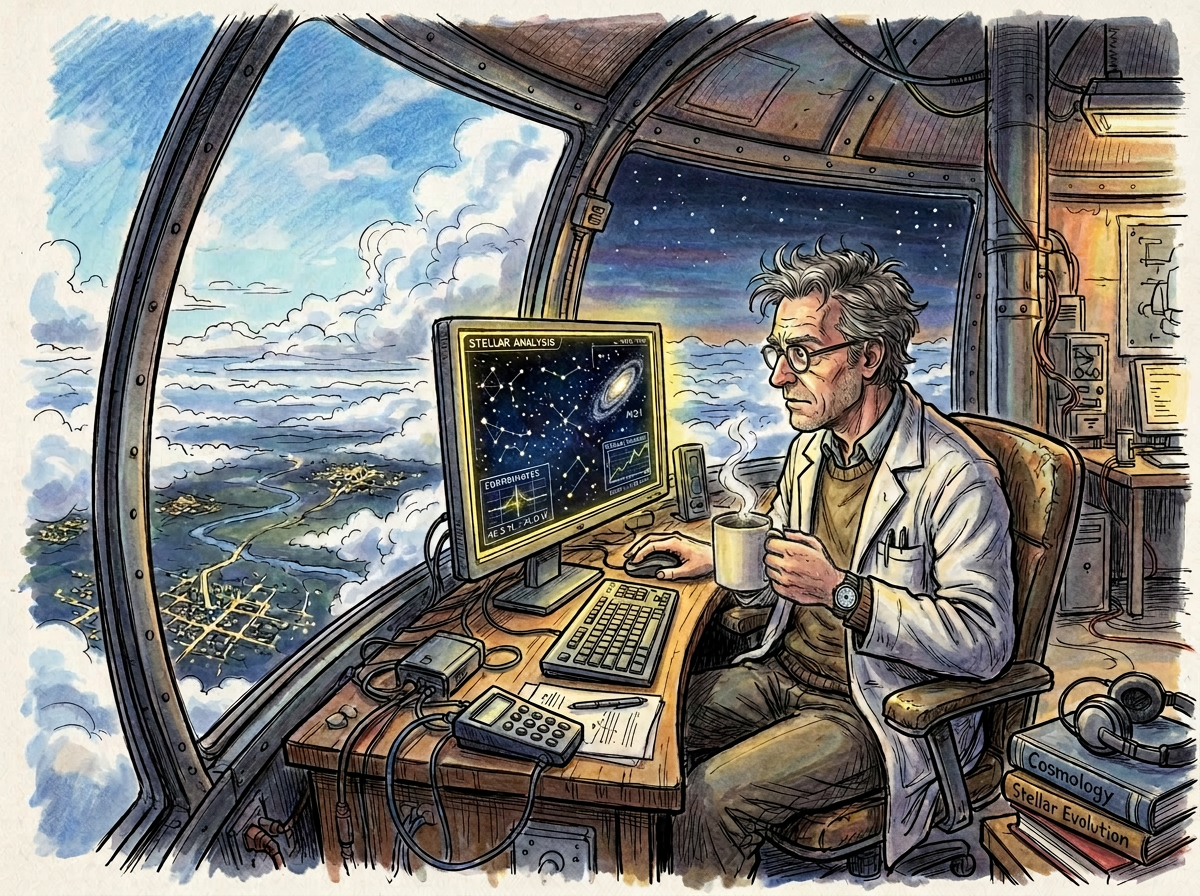
Observer
It's the coffee. I notice it because I have made it the same way every morning for the past six years. The stream bends slightly to the left...just a bit off.
I hold the kettle still, watching the arc as it narrows into the cup. The smell is unchanged. But something's not quite right.
"Calibration?" I say.
The console light wakes beside the counter. "Local gravitational variance within acceptable thresholds," it answers. "No adjustment required."
"Log it," I say.
The observatory sits above the cloud line, far enough from the cities that the sky still behaves like a sky. No satellites drifting through every frame... just stars, fixed and quiet. In practice, nothing is fixed. We measure everything: position, luminosity, redshift, gravitational influence. It is a closed system of attention.
I carry the coffee to the main console. The surface trembles slightly as I walk. A faint oscillation, like the cup is remembering motion.
"Begin comparison," I say.
The stars arrange themselves across the display. There is a delay. The pattern resolves. "Alignment deviation detected," the system says. "Magnitude: negligible."
"Show me anyway."
The display shifts. A cluster in the northern quadrant - catalogued and stable for decades - has moved. Not drifted or redshifted, just moved. The change is small, arc seconds, but I am looking for it.
"Historical overlay."
A second set of points appears, ghosted over the first. They do not match.
"Error margin: 0.003%," the system says. "For most applications, it is negligible."
"This is not most applications."
At noon, I switch to tea. It is a habit I picked up from Dr. Ionescu, who worked this station before me. She believed in dividing the day cleanly to create a rhythm.
"Attention requires structure," she used to say. "Otherwise, it dissipates." I remember the way she would stare at the edge of the desk, her eyes wide and unblinking, as if she were trying to hold the wood in place with her mind. Toward the end, she didn't just watch the stars; she guarded them. I used to think it was the isolation. Now, I watch the tea.
The steam curls upward. It does not rise straight. It wavers, as if the air itself is uneven. I hold my hand above the cup. The heat is consistent; the motion is not.
The second anomaly appears at 14:17 in the instruments. A pendulum, used for baseline gravitational calibration, completes its swing 0.02 seconds faster than expected.
"Explain," I say.
"Micro-fluctuations in gravitational field strength," the system says.
I pull up the archived logs. The line began to ripple four years ago. Always within "acceptable" thresholds. "Correlate with observational activity," I say.
The graph splits. One line for variance, one for human-initiated observation. They mirror each other. When observation drops, variance increases.
"No known causal relationship," the system states.
I make another cup of coffee. The kettle hums. I pour. The stream bends even more than this morning. The surface of the coffee shifts, a slight asymmetry that takes longer than it should to resolve.
"Is gravity decreasing?" I ask.
"Local variance remains within limits that do not significantly disrupt human function," the system says.
I laugh - a short, dry sound. "Human function. That's the metric."
"Live feed," I say.
The display hesitates, then resolves. For a moment, the stars flicker - a stutter in reality, as if the positions are being recalculated in real time. I see it on the desk, too. The grain of the wood blurs for a millisecond, then snaps back into focus.
"Did you see that?" I ask.
"No anomaly detected."
I watch the screen without looking away. The stars hold, then slowly, almost politely, the cluster moves. "Alignment deviation detected," the system says. "Magnitude: negligible."
"What counts as observation?" I ask.
"Any directed measurement... Human-directed," it says. "Automation contributes less significantly. Human observation includes higher levels of interpretive engagement."
I think about Ionescu sitting here long after her shift ended, just looking. She wasn't being eccentric; she was working. She was the anchor.
"How many active observers are there globally?" I ask.
The number appears. It is much lower than I expect. Automation has replaced the work: systems watching systems in…