Better Not To Have Seen
Chapter 1. Chasing a Robinson
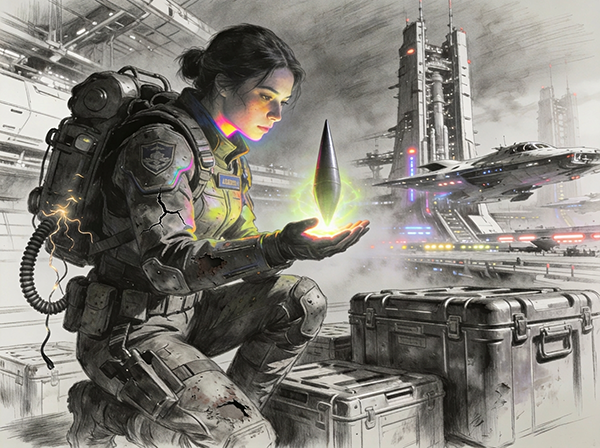
No one fails space parcel duty! Ensign Palladia Comté peered out the engine compartment windows and was forced to agree with the sensor display on her shuttle’s main screen. There was no planetary system in sight, and the parcel was nowhere to be found.
The sending slingshot’s advance manifest had listed an unfamiliar Science Tag, Earth origin, and not necessarily Navy property. That the Navy was handling delivery meant it was probably something classified. It made sense that they would pick the most obscure region of the Sirius complex for their gravity brake. And she did her best to be there when it got there. Unfortunately, there was nothing there.
If they sent it to these coordinates, with nothing to slow it down, it could be well on its way to a fiery end in one of the nearest stars. She had half a mind to file it as a Robinson. But, damn, it could be classified.
“Ping the parcel again.”
“No response.” Even the AI was starting to sound irritated.
“Increase gain, as loud as you can.”
“No resp –“
“Wait, what was that?”
“Spectrum consistent with a sideband echo from a planetary system buoy.”
“Really? Take me there.”
She found the echo, almost a parsec away. That’s some progress. It was indeed a planetary system reference buoy; and it had been mis-installed. “You know, the fact that it’s orbiting a pile of rocks in the middle of a proto-planetary debris field ought to have been clue enough to whoever installed this thing that they made a mistake. But, as my uncle used to say, space isn't the deepest vacuum out here.”
The AI did not respond to the obviously rhetorical chatter.
“I knew you’d agree.” Clad in her EVA suit, she inspected the buoy’s surface. “No damage from the debris field. Here, I’m downloading the installation log for the report. I can’t get the delivery routines to respond. Best I can do is reboot the operating system.” That elicited a response. Within a minute the buoy activated its thrusters and initiated its return-to-home protocol. “I guess that’s a return to sender.”
Back inside, she dropped into the pilot’s seat again and slouched. “Well, if the drop coordinates were using that buoy as a reference point, now we know why we can’t find the parcel.” At least it wasn’t my fault.
The pick-up shuttle's AI responded to the pause in her musings: "Return to base?"
"I – I don’t know. No, no. How unlucky can we be? We can't be that far."
"Please specify desired reference point."
"You tell me. Still no ping back, right?”
The AI obliged. "No reply. Parcel may be out of range."
"Try the Combat Search and Rescue bands."
Half a second later: "No active beacon detectable."
Figures. It’s either not important or too important to announce to the universe it’s lost.
"How about this? Broadcast Downed Combatant Override."
Not even a tenth of a second later: "DCO requires Lieutenant rank authorization."
"Do you detect an officer of higher rank in this ship?"
It took the AI a full minute to slog through that quandary. But Palli knew the inevitable answer. After all, the post-retrieval shuttle was a Navy ship, and you can't have a Navy ship on its own without a chain of command, even if all you've got onboard is a 20-year-old ensign. Within minutes of the DCO broadcast, the parcel's beacon started calling. "Let's go."
It was a strange résistance that caused no direct pain, inflicted no direct casualties on the enemy, but still accomplished a purpose. Ehon, Vadere, her brother Jmin, and a handful of others had worked subtly over the last nine months to shorten their oppressors’ visits.
By keeping their own inventory records, they could anticipate the supplies the pirates would need on each return and queue them up near the front of the storage buildings. By doubling the cleaning crews, when they were busy elsewhere, they cut in half the time required to restore their ship's life support matrix; and it gave the extra hands time to scour through the refuse piles before all the debris was consigned to the metal recyclers. That was how they had discovered the microwave amplifier, in the burnt-out core of a discarded ship cannon.
Eventually, their equipment-scavenging missions had garnered enough parts to cobble together a high-power radio transceiver. This night was the culmination: Their first long distance transmission test. If they could bounce a signal off one of the dead orbiting satellites, the decades-long nightmare could come to an end.
They first trained the transceiver, in receiving mode, on the night sky and listened for the Harnachi ship, even though they did not expect them to be back for at least a week. Their usual bi-weekly incursions had been stretched out to monthly stopovers for the last one hundred days.
They were not supposed to be there.
As Palli approached the planet, she tried to contact the inhabitants on every standard communication channel, to no avail. Once in orbit, she knew why. Every one of their orbiting satellites had run out of power at least four decades prior. She tried to find some broadcast channel in use, but all the aether held was noise. She would have thought the outpost was uninhabited, its original colonists long dead, if she hadn’t filtered out of the ionospheric static the telltale signs of a primitive AC power grid.
That first orbit revealed much more. They were open-pit miners. No one mined this way anymore. The last such mine in Sirius Alexandria had shut down operations sixty years ago. Based on its location, this colony had to belong to Sirius Phoenix. They had become environmentally conscious at worst half a decade later. As a result, within one generation, their radiation-hardened genes had stretched the Sirian expected lifespan beyond the century mark. But these people were stuck in the past. Under these conditions they couldn’t live past 50.
Palli winced at the next thought that crossed her mind. Under these conditions an unprotected normal human would die in less than a week. Unprotected, as a Deneuvean hybrid, she could survive perhaps two weeks, but the damage would be beyond genetic repair in four days; and her eyesight would be gone in less than a day, the aqueous humor bleached by alpha ionization.
Don’t they know better? Obviously not. Their satellites were long dead. The space buoy that was supposed to have linked them to the rest of the universe per the Accord of ‘37 had been misplaced, 200 milliparsecs away, with its registry in the Postal system database off by another parsec, in a completely different direction. The only reason she found them was because of the parcel.
On the second orbit, the VIS sensors identified a landing pad at the center of a triangle of personnel compounds. "There’s no one around,” she said aloud. “Can you tell when was the last time a ship landed there?"
"Unable to comply. Planetary ionosphere parameters are consistent with a Kelvin planet. Hyperspectrometry suite calibration is invalidated by active ionochemistry. Daytime ionosphere most likely extends to the surface."
"And they let their satellites go dead? Never mind, don't answer that. My guess is they don't care for visitors. Initiate find-log record but don't transmit until we have a secure line." There's something fishy with that buoy mis-install.
"Recording."
"Comté, Palladia, Ensign; parcel find-log. Unmarked Sirian mining outpost located at the appended coordinates. Colonists possibly subsisting under hazardous conditions. No distress signals detected from the surface. No response to communication attempts. Proceeding with parcel recovery. Recommend follow-up from Sirius Phoenix Authorities."
She waited until the parcel's beacon crossed into the planet’s nightside, and she went down via drop pod; close enough to the beacon coordinates to be able to pinpoint the parcel’s landing spot and still far enough from the nearest personnel compound to be discreet. Pick it up, leave unnoticed; that was the plan. It didn’t work.
The pirates should not have been there, but they were. Somewhere below the horizon, the pirate ship's landing radar had already been trained on the planet.
"Why are they back?"
Ehon's grip on her arm, steadied Vadere. "We haven't been discovered. We will try again." His eyes had almost settled her heart when a deafening burst of suit-to-ship telemetry screeched into the night, heterodyning through their transceiver’s audio-relays. They followed the interference racket up the hill, not knowing what to expect — certainly not one of them. But that’s what she looked like, in full exo-suit.
Being clad to the hilt like a walking decompression chamber rendered her first meeting with those eyes equivocal. The language should not have been a problem, but the rate of delivery defied translation. The woman before her was hyperventilating. The two men that followed her over the ridge, carrying some sort of equipment, were just as startled. Ensign Palladia Comté, in full environmental exo-suit was indeed the focus of their panic.
The sheer terror at being discovered, after being so close to hope, had sent Vadere into hysterics. She rushed at the mechanical monster, trying to draw all attention to herself, instinctively shielding her beloveds, hoping that her brother and her husband would run off into the darkness undetected. Jmin was the first to realize the difference in the suit. But it was little consolation. He pulled his sister back. Even if they had not been discovered yet, they would be if they stayed there. One look at the instrument Ehon was carrying confirmed it. The Harnachi ship was out there, its thrusters were firing, and it was headed this way. If they had not heard her transmission, they surely had seen her ship in orbit.
Their eyes met again. Palli loved those eyes. One of the men had them too — deep purple. He grabbed her suit’s arm and repeated his words slowly enough for the meaning to clear the corners of the accent. "You are in danger." She couldn’t expect him to understand that she would be fine. She was wearing an Engine Tech suit, three generations beyond anything they had ever seen. It had enough Himalon to withstand the mother lode output of their worst open-pit mine.
"I didn’t mean to intrude." She spoke haltingly, edging her consonants as they did. Tapping the pad at her shoulder snapped open her ID pack. "See? Earth United, Navy Postal Det—" The glances exchanged sent two conflicting emotions ricocheting around the trio before her: hope and dread. The purple eyes clung desperately to the hope. The dread settled on the man with the yellow-green eyes. They called him Ehon. With a barely perceptible shiver he molded the dread into determination. He was the leader. "What’s wrong?" She had to ask.
"How big is your ship?"
"A pick-up shuttle, designed for two. I am the sole crew."
"Cease all transmission!"
"Yes, Sir." She tapped the command into the virtual keyboard.
The man glanced again down at the display panel of the oversized instrument that hung over his shoulders and chest, and then back up at the sky. From this vantage point, in this darkness, her orbiting ship would be visible any minute as a drifting silver speck, about the size of a pea. It should have been. But the flash that crossed the horizon was yellowish and much larger, and much faster. "How did you come down?" The leader asked.
"Drop pod, 450 meters in that direction." Her eyes went from his again to the sky, extrapolating along the trajectory of the yellow star...to hers, 15 degrees ascendant. Two flashes lit the sky. "What the hell? Wait, you can’t do that. That’s my ship!" Her screams at the night made no difference. The yellow orb slipped past the dimming cloud that replaced her silver speck. A cold shroud of fear started to replace the outrage, but his eyes forced her to regain control.
"Is your shuttle ever deployed unmanned?"
"No."
"They’ll know that. Quickly, we must destroy your pod."
Her drop pod could reach orbit and maintain it for 32 hours, but there was nothing up there to rendezvous with anymore. Together, they removed all the communication equipment from the pod, and the brother and sister of the purple eyes vanished into the darkness with it. She and the leader carried the pod down the backside of the hill to a steaming swamp. With her suit’s force amplifiers bearing most of the load, they covered the kilometer in less than 10 minutes. But that consumed a full hour’s worth of filtering power.
A sharp motion from him warned her to step no closer. From a safe distance they started the large metal ovoid rolling toward the glistening surface and then they stepped even farther away. The suit’s environmental spectroscope detailed for her the composition of the boiling chemical soup before them. Superheated piranha-etch would have only diluted it. In a matter of minutes, the bronze surface of the pod started flaking off in gray shards that vanished under the roiling surface. That swamp confirmed her first orbit's conclusion: open pit miners working under conditions abandoned more than five decades ago.
"The parcel!"
He turned at the stress in her voice.
"It’s transmitting too."
He glanced down at his instrument, puzzled.
"It's on a Laplace carrier. I can’t shut it down."
"There’s no time."
Without the load of the pod, they made it to the edge of their compound just as the golden ship’s landing thrusters lit up the horizon. They hid her in an abandoned subway dock. Its lead-lined walls were thick enough, and its emergency pressurization system clean enough, that she could shut down her suit and conserve power. A hardwired intercom line gave her a black and white view of the surface. What she saw shook her to the core.
Chapter 2. Children of the Enslaved
The men in the battlesuits spoke to each other in Harnachi. She understood almost every cruel word they uttered. It was like watching an old space-pirates movie, except it was all real. It took a day of public beatings before they were willing to believe that their luck had been so extraordinary, that the pilot of the orbiting shuttle had actually landed in the middle of one of the acid swamps.
As soon as they left the compound, Vadere, the woman of the purple eyes, and a tall, slender older man joined Palli in the subway dock. The physician’s manner was unmistakable. He placed her arm inside a bucket-sized piece of electronic equipment and nodded in satisfaction at the flickering dials. As he made his annotations in a hand-pad, Palli realized her blood and DNA were being analyzed by an instrument resembling a 250-year-old television set.
All of a sudden, the size of the instruments all around her made sense. In a Kelvin planet, with a mantle full of transuranics, the surface continuously bombarded by ionizing radiation, semiconductors didn’t have a chance. All their technology was based on vacuum tubes, incredibly bulky but impervious to latching or breakdown. It was the only alternative up to half a century ago. They never got fermitronics.
"Palladia, you are not Sirian." He allowed her to withdraw her arm from the instrument. "Yet the blood parameters are so similar. Are you also from an engineered race?"
"No, no, humanity only made that mistake once." She instantly winced at her choice of words. These people standing before her were the product of that mistake. But they weren’t mistakes. The quiet nod from the Doctor meant that he understood full well what she meant; too well. She hid her face in her hands. She still could not believe what was happening. It was like stepping back in time over a hundred years. Slavers — "Slavers!" She paced about the room. "How? This was taken care of eighty years ago."
Palli had felt sick to her stomach when she first learned about it in school, that she, a hybrid, only half Terran, would have at one time enjoyed a higher citizenship status than these people. But it all had been fixed, amends made, humanity restored. It had. The world-wide protests of 2207 were the turning point.
The Earth United Congress had taken on the whole Civilization Conference, unilaterally revoking the sentio-genetic ownership laws in all its territories. When the multi-planetary conclaves holding the exclusive rights sued for a restraining order in the Civilization Conference High Court, declaring a breach of interplanetary commerce law, the Terran Congress responded by voiding every gene patent that had been issued to secure rights to the 'novel radiation-hardened humanoid bio-system'.
The boldness of that move took even the Civ Con council by surprise. Many allies of Earth urged them to reconsider, agree to arbitration, seek a reasonable settlement. That was too much for Earth Representative Derek DuPris. He walked off the Council floor and, as representative of one of the three Re-founding Civilizations, he called for an Emergency Founding Council meeting. Normally reserved for situations of imminent interplanetary war, that call brought Civ Con to a screeching halt.
His speech before the Founding Council, a week later, was historic; since then, required reading for every citizen of Earth and everyone who believes in the innate liberty of the sentient soul. He crowned it with a devastating scientific exposition. Under his direction an interplanetary team of Space biologists and Xeno-biologists had been performing a complete remapping of the Sirio-Terran genome. Their findings made even the head of the multi-planetary conclaves sink in his chair. Not one of the originally designed radiation hardening mechanisms was at work inside the bodies of the genetically engineered Sirio-Terrans. And yet they survived their radiation-laden environment.
Super dense cell membranes, designed to resist ionization damage, had reverted to the normal Terran membranes. Instead, their cells quintupled their number of mitochondria, supplying enough energy to effect cellular repair at an accelerated rate. Defective DNA was not destroyed but recycled. Cancer was not forestalled by triggering the cellular kill gene at the first sign of uncontrolled duplication. Instead, a new 'halt' gene had appeared, preventing a diseased cell’s duplication but allowing it to remain as a source of energy and structure until it could be replaced. The list went on. The conclusion was inescapable. Derek DuPris stepped down from the podium and delivered it face to face to the head of the conclaves:
'The first generation of radiation-hardened humans died before age 30 because outside the laboratory your genetically engineered template was an utter and complete failure. Their children survived only because they mutated away from that design into a viable alternative, by the mercy of Nature and Nature’s God. Now, four generations later, their life spans can reach well into the 60’s, if they can avoid mining accidents. If you deserve anything, gentlemen, it is a criminal conviction for placing a colony of sentient beings in a lethal environment that led directly to their untimely demise.'
Almost a century had passed since that fateful day; and the standard of life for Sirio-Terrans had been steadily improving. Most chose to remain in their assigned planets and continue to mine them. That way of life had become their culture. Besides, no one else could do it. They were the only humanoid race capable of surviving intense radioactive environments.
It was a hard life, but at least now they had the freedom to trade their own product, to negotiate, to profit from the labor of their hands. The few that had decided to venture into the rest of the Civilization Conference had made a name for their own. Gifted musicians and mathematicians, with a lifespan estimated at 120, they raised the level of humanity’s culture one more notch. Some had even become ranking members in the administration of the Civilization Conference.
"How? How did this happen?"
The Doctor sat down, and that brought Palladia’s pacing to a halt. "Our Space Support Team never arrived. We went ahead and set up camp. We had our own schedules to keep. Within a month, production was ramping up in all three of the mining centers and consumables were down by 20%. And then we waited, and waited. We knew radio could barely get through the ionosphere, but the weather satellites should have been able to act as repeaters. There was no reply.
"We used up all the automatic message pods. No answer. When the anniversary date came and went without the requisite visit from the Colony Assay Office, a group of engineers decided to rebuild one of the landing rafts and try to get beyond the magnetopause. We never heard from them again."
Abandoned. Forgotten. It was a colonist’s nightmare. It should not have been possible. Sirian mining colonies always ended up at the hub of a trading circuit. Their fission products were standard fuel for low cost deep-space tankers. In fact, the market demand this far out on the Sirius complex should have been high enough to guarantee at least a ten-planet trading circuit, profitable enough to forestall any temptation to dabble in the weapons-grade black market... as long as someone knew they were out here.
It didn’t take long for Palli’s apprehension of the men in the battlesuits to become a deep hatred. Their plan had been utterly cold-blooded. As one of the long-lived species of the Galaxy, the Harnachi were famous, no, infamous for their long-term vision. From somewhere in space, they must have intercepted and falsified all outgoing signals, somehow warded off any attempt at reconnecting with the colony. And then all they had to do was wait, however many years it took, to make sure the Sirians were desperate; so long that ninety percent of the original population died, victims of curable autoimmune disease and worse.
Sirius Vesuvius had been well named: dangerous even to a people bred to survive intense irradiation. Palli recorded the full story in her personal log. Because, to do so, implied she believed she would make it back to base, safe and sound. She had to believe that.
The doctor went on. "The original plan had been to rotate crews every six months, and to fashion a new generation of booster treatments from their blood plasma. Without that option, the best we could do was dismantle the deep-dig platforms to fashion a few, select, reduced radiation havens. The two spin-bins from the ore-refining stations became the hubs of our hospitals, the subway docks became maternity wards."
Like their ancestors, they were reduced to hoping that children born under these conditions, the ones that survived, would be better adapted. And they were, marginally; but the same became true of a few pathogens.
"Something like rheumatic fever swept through the botanists' quarters. Despite all the attempts of the medical crews, the victims died one by one, until only a young girl was left. Her aunt, her last living relative, a forty-seven-year-old toolmaker, came to us with a desperate plea. She was willing to give up her life that her niece might live. She was offering herself as a living heart-transplant donor. She had an answer to every objection, even arguing that under these conditions she herself had less than five years to live, but her niece had thirty or forty if we would just give her her heart.
"The arguments raged around the clock for four days, ethics of communities versus the individual, Hippocratic oaths standing in the way of saving a life by destroying another. And the girl only got weaker. And then came the accident that no one believed was really an accident, a reactor steam pipe explosion. The overpressure alarm sounded just in time for the emergency crews to evacuate most of the workers, but not early enough to prevent the blast. It claimed the life of the woman, instantly killing her but leaving her torso, and her heart, undamaged."
Palli's eyes steamed at the telling, and every time she remembered the story afterwards. The transplant specified in the woman's last will and testament was performed, and the miracle discovered: Their tissues had become rejection proof. The niece’s body accepted the heart as if it had been her own, without a trace of trauma. The same mechanism that had allowed their cell membranes to resist free radical corrosion now foiled all tagging attempts by white blood cells. Just as the supply of radiation blocker and tissue repair drugs was nearly exhausted, Nature and Nature’s God had once again taken pity on these people.
That discovery gave them a new lease on life. Soon every physician became an expert on transplant science, and every citizen a willing donor. Mercy suicide was still outlawed but no one would stand in the way of the head of a family willing to take a risk and donate a spare kidney, or a lung that would be compensated by the other one growing larger, or half a liver, or even heart tissue, because the heart can beat just as effectively with less.
Vadere picked up the story. "A year later, our material scientists engineered Hypermalon, a Boron-Himalon polymet, with ten times the radiation shielding strength of Himalon. And so, by the time our population had been reduced to one tenth of the original number, the mortality rate finally dropped below the birth rate." Vadere's grandmother was born to that generation. "If only they could solve the food problem, there would be hope."
And then the slavers came, offering food and some medical supplies in exchange for weapon’s grade fissionables.
It was illegal, it was black market tender, it was blood money still dripping from the touch of revolutionaries and would-be planet presidents. But they had no choice. The slavers were buyers and traders and suppliers. They made the rules. And they kept their traffic precisely within the parameters that made it undetectable by the Space Trade Monitors.
On the third year of bondage, a young man arose as leader of his people. He almost convinced them that Sirius-Vesuvius was better off dead than tainted with the blood of the oppressed. The slavers promptly reminded them what blood was. They stopped their carnage at the point that would guarantee their next load of fissionables would only be short by 25 percent. No father, no brother, ever risked the life of his family again. But they did not give up. Ehon’s grandfather didn’t. Ehon’s father didn’t. Ehon didn’t.
That night, Palli studied the recording she had made of the public beatings and interrogations. To her it seemed that the pirates had cut them short. They did not even bother to enact any other retaliatory measures.
Vadere confirmed that.
"They are distracted," Palli concluded. "They were going somewhere else, when they returned."
"Yes," Ehon replied. "They probably came back because they saw your ship in orbit."
"How long before they leave?"
"They usually wait till morning, let their ship's life-support matrix reconstitute overnight."
"They haven't bothered to leave a guard on their ship." She glanced at the landing pad remote monitor and got an assenting nod from Jmin. "My suit has no weapons. But while your people are unloading the waste bins I can slip into their ship and sabotage it. Those kinds of thrusters need fulltime active cooling, especially when they transition to trans-luminar drive. I can disable the cooling loop, re-route the warning circuits."
"Their ship will-"
"Fireball on the edge of the system."
"No." Ehon replied.
"No? Why?" Her hand stabbed in the direction of the monitor screen. "I can end it all."
"No."
"Look, Ehon, I don’t see any other option!" She stopped tempering the volume of her voice. "There’s enough firepower in those battlesuits they are wearing to level a small town. My exo-suit control pad can commandeer the ship, but if I just take off and manage to dip behind the horizon before they shoot me down, what do you think they’ll do? They’ll get rid of all the evidence. There won’t be a man, woman, or child left to tell what happened in this colony." She spun to face his yellow-green eyes squarely. "There is no scenario in which I can leave one of them down here with you while I go get help. The only way is to destroy the ship with all of them in it."
"We will not murder another human being."
"Not even beasts? They gave up the right to be called human long ago. I saw what they did this afternoon. I have talked to Vadere. I know what they are capable of."
"We will not murder."
They had no compunction against it.
Chapter 3. The Price of Freedom
Palladia joined their résistance that day. Melanin enhancers quickly darkened her ivory skin to the deep mahogany typical of Sirio-Phoenicians. Vadere made her a Hypermalon body suit. One of the optical engineers fashioned her a pair of non-refracting whole-eye contact lenses as an additional safeguard behind the shielding goggles she wore any time she stepped outside the subway tunnels. Their conventional miner’s face mask provided sufficient Radon filtering, as long as she kept up with her daily radiation-blocker dose. The drug, formulated for Sirians, seemed to be working adequately for her.
Her Navy training and her undergraduate avocation of electrophysics proved a boon to their radio project. Parts they had never thought of stealing and parts cannibalized from her exo-suit soon gave their transceiver military comm band capabilities.
And then they found it.
"Palli, we found the parcel." Ehon ushered a cousin of Vadere and Jmin to the meeting table. "Viviana told Anachelle who passed it on to Motad. He verified it while refurbishing their water filters. It’s in their planning room in the temporary quarters they use during ship decontamination. Viviana heard them talking in Earth Standard over their comm link. She says they were able to open the outer casing but the package inside is sealed. They are afraid of taking it inside their ship, something about self-destructing Navy property."
Palli managed a smile at that. It had been two months since she had landed. The slavers had picked up the screaming parcel the next day and turned off its beacon. No one had heard of it or seen it since then. But after a week, they never left their camp unmanned. One of them remained behind, every time the ship left. Since then, a rolling uneasiness, beyond the obvious threat to her life, had kept Palli’s nights short and her sleep light.
If the parcel contained classified data, to whom would they sell it? Civ Con had enemies. How much damage could it do? And how much of it would she be responsible for?
If I had only reported the misplaced buoy instead of trying to repair it... Relayed my findings up the chain of command rather than chasing the parcel here on my own. Someone else would have come for it, with a real ship and real weapons.
Recrimination was an easy pit to sink into... But then again, if she had reported it, the Navy may just have given the parcel the self-destruct command, and no one would have ever known about Sirius Vesuvius or its indomitable people, with eyes of deep purple and blazing golden-green, able to survive the most brutal environment ever seen by man or ever made by man.
"They are negotiating with someone to take a look at the crypto-lock," the young man went on, snapping Palli out of her thoughts. That was bad news. They had to do something, quickly.
"They’ll have to bring whoever it is here themselves, probably blindfolded. They are not about to give out this little secret to anyone. That means there will only be one of them down here for the next couple of days, guarding it as usual." Palli paced the floor as her plan fell into place. The active mode of the communications package in the parcel’s case had more than ten times the range of the rescue beacon, enough range to reach the nearest Civ Con outpost. That meant they could risk sacrificing their present radio transmitter for it.
She reviewed once again the wall map of the original colony. Three mining sites had been set up at the corners of an equilateral triangle 200 km on the side, each one originally intended to support ten residential compounds. The northern pair of mining sites had been abandoned long ago and the population moved to four residential compounds in the southern site. The slavers had taken over the landing pad at the center of the triangle. There they set up camp, collected their deliverables, and handed out the supplies that kept their 'workforce' alive. "They don’t know that the subway trams are functional, do they?" She addressed both Ehon and Vadere.
"We have not used them in over twenty years. They consume too much power."
"But they are so conveniently arranged. What is their top speed?"
"Eighty kph, but they are forced to stop at every station between centers."
"Still, we could use the landing pad track to slip under their camp undetected. With only one of them here, and careful coordination, we should be able to hide your radio unit and other equipment in this alcove adjacent to their planning room. We’ll place a lookout in this building across the road facing the room. Then we wait for their return. When they open the external casing’s crypto-lock, they will have less than three minutes to open the inner one before the parcel goes into self-destruct mode. However, we can reset the clock." Ehon’s reaction made her pause. "No, I am not going to blow them up.
"Listen. An exposed inner casing has minimal shielding from electromagnetic interference. They were never designed to be opened in this kind of atmosphere. In less than fifteen seconds the constant bombardment of ionizing radiation will have created enough microplasma inside the casing to turn the whole thing into one continuous antenna. A single high-power noise burst from your radio, and every exposed card connector will arc, making the parcel think it is being torched open. It will switch immediately to self-destruct mode, sound the seal-breached klaxon, flood the area with a noxious warning gas, and start a 30 second countdown to detonation. That will give them enough time to get out of there.
"While they are high-tailing it, I go in, use my Navy ID strip to stop the countdown, and sequester the package and case. In twenty seconds, we are back in the subway tunnel and you detonate a dig-explosive in the adjacent room." There was a minute of silence. Palladia stepped away from the table. All acknowledged the risk, but no one could find a flaw in the plan.
"They’ll think it was an accident." Vadere nodded.
"Then, next time they leave, we use the package’s comm suite to contact the Navy... and the nightmare is over."
It wasn’t.
The plan worked.
The radio burst triggered the parcel’s self-destruct mode. Three of the men in battlesuits were out of the building in an instant. The other two had to drag the shocked Buden-Ami crypto-hacker out of the room by the frame of his environmental suit. Ensign Palladia Comté raced into an increasingly darkening room. Within three paces, the table had disappeared. She stumbled into it, fumbled for the parcel and felt its klaxon shrieking through her bones. The next second she realized what was happening.
The warning gas was attacking the surface of her goggles, pitting them into opacity. She snapped them off and with them the miner’s mask. She had twelve seconds of visibility before her contacts suffered the same fate. Her Navy strip did the job, she managed to unlatch the parcel and almost make it out of the room, out the wrong door.
She ran into the side of one of the slavers, coming back with a blast confinement crate. He almost saw her, but Ehon was there, with a mining torch. With one sweep he cut clean through the battlesuit’s air supply pipes. The man’s survival instincts took over and he blasted his way out of the building. Ehon had enough time to shove Palladia into the subway tunnel and seal the floor. He set off his own explosive just as a second armored man rammed through the wall into him.
"Palli, Palli, wake up." She did, in mid scream. Instantly self-conscious she wiped away the sweat at her brow and the tears in her eyes. The first flickers of dawn were shining through the Himalon curtain. If she concentrated, she could still make out the color. She sat up and forced composure onto every part of her body.
Steady! She ordered herself. But the vestiges of the nightmares refused to let go of her consciousness. Both nightmares had ganged up on her that night. The first one had come to her many times since she had joined these people. It was built on the memories of her night of arrival. It ended the same way every time: They dropped the pod. They ran. They made it to the outermost house of the compound and then the shrill whine of a particle beam sliced across their backs and ended it all.
She did not need a Psych-Counselor to interpret that dream for her. She’d rather be dead than face this, than being responsible for all their lives. The second recurring nightmare was only two days old and it added shame to the terror. Shame, because it had been her plan. It always followed the first in the penumbra of half-wakefulness, when her mind realized that she did not really die that first night. It came in a train of sickening jerks, the way her dazed mind had recorded it:
~*~
They herded Ehon’s whole family to the platform in front of their ship, not even bothering to bind his broken arm. A shipping container of warhead lancets lay open on the table. With a barrage of filthy language laced with vicious threats, the towering leader of the slavers made it clear that the only reason any Sirian was alive was to supply them with the objects of their trade. He picked up one of the lancets and with a quarter of a turn unlocked its damping sheath, drawing out the uranium core. Palli flinched as the man’s battlesuit particle counters loudly protested the radiation bombardment.
He paused to admire the smooth conical surface, a 25-centimeter radioactive spear-head perfectly shaped to fit the nose of hypervelocity projectiles. The slaver smiled a cruel smile as his glove’s mechanical fingers traced the surface down to its glistening needle-like point. Then with a savage thrust he plunged the lancet into Ehon’s chest.
Palli couldn’t shut her eyes in time. She saw the metal flash in a burst of intense light and heat, as water-filled tissue and solid bone reflected back the neutron flux onto its blazing surface; it flashed again and again in a boiling chain reaction that consumed everything around it, flashed until sinew and tendon caught on fire... flashed until a man was reduced to a smoldering heap before her very eyes.
She was glad she was going blind. She kept telling herself that when her physical sight was gone, then too would be gone the nightmare. If she could only turn time backwards. But that’s not what the parcel could do.
~*~
The Harnachi ordered their workforce back to their compounds while they searched through the rubble. And that night, Palli finally understood the stakes; and explained it all.
"It’s an entropy exchange engine." The involuntary wonder in Palli’s voice gathered the huddled group even closer to the dining table, around the treasure from the parcel. She would have smiled, broadly, giddily, if this had been anywhere else, any other time; but the nightmare hurt too much.
She started to explain. "They have been around for forty years but never this size. This thing — it’s the size of a palm-top comm unit. The new one built at the Navy Research Labs just last year occupies a room as large as your subway docks." She paused, not sure how to explain any more in terms of their technology. "I don’t understand the miniaturization technology; the documents call it gauge bonding. But the device works the same as the standard units. It makes time displacement fields."
"You can tamper with time?"
"No, not time travel... Bubbles of local time distortion. They attach to high density objects, like metals. A time-forward bubble accelerates local time; a time-back bubble slows it down. The medical applications alone are staggering, and they are finally possible." She picked up her water cup and swept the tip of the machine past the spot where it had been standing. Then she turned the cup upside down. The water poured out, hit the table, and suddenly stopped, or almost seemed to. Before their eyes, the liquid continued to splash upwards and outwards in slow motion. Like a crown of transparent gelatin, it grew in size, splintered into spheres, and coasted off the edge into a shower of beautiful parabolic strands.
In seconds, the pieces returned to real time and plummeted to the ground. Jmin and the others had to touch those wet spots to convince their senses that this had really been water. Vadere’s purple eyes went up from her fingertips to stare off into space for a second, with the same wonder that had momentarily taken over Palli. Then reality also brought her back. "Is it a weapon?"
"It could be. Theoreticians at the De Broglie Institute believe it could be the foundation of a new kind of transluminar propulsion."
"For this they kill..."
Those memories yielded again to the reality of the new day. Palli shook her face. To keep the nightmares away she had tried to stay awake. But at some point, in the middle of the night, her body had wrested control over her will and cruel sleep took over, until morning brought a respite. She stifled a deep sigh. She was their only hope now. I am trained for this.
"It’s OK." The voice’s kindness matched the glow in those purple eyes. Palli steeled herself at that meeting of eyes. She couldn’t let them see how scared she was. How could Vadere’s eyes be so steady? Her hand tightened around Palli’s momentarily, and she felt the answer. The strength within the older woman ran throughout her whole being. It was an integral part of her, of them. How else could they have survived this long? Even when the world fell apart, they stood. Even when the past was inconsolable and the future unbearable, they stood.
Tears welled up within her eyes as the mixture of fear and shame returned. She forced herself to stand up. In a controlled daze, she made her way to the breakfast table. Jmin prayed the blessing over the meager fare. Palladia Comté, counted off her options in silence with every bite of the olive flavored bread. She ran out of them and of appetite at the same time. Without a word, she stood up with her plate and walked away from the table. Stopping at the recycle bin, she found herself kissing the remainder of that slice of bread – like they did, like Ehon used to do – before throwing it away.
The recycle bin vanished with those thoughts into the shadows of her peripheral vision, and she turned to the breakfast table again. "We know they have been going through the debris the past three days. It’s only a matter of hours now before they figure out that the package was not destroyed. They’ll come and they won’t stop until they find it." A look around the table confirmed there was no last-minute change of heart.
Chapter 4. Exodus
The slavers came that afternoon in their hover shuttle. Behind them, three columns of rolling soot stabbed into the sky, the only signs that there had been three other residence compounds on this mining site. But there had been no one there. To all appearances, the entire population of Sirius-Vesuvius had retreated into the alpha compound. Transport vehicles and mechanical shovels had been piled up in layers around the central buildings. The Harnachi landed just beyond the makeshift barrier, not knowing what to expect.
Three days ago, an attempt had been made on their lives by these miners. This morning: three empty compounds. And now this, an entrenched resistance? The Sirians had not shown this kind of aggression in decades. They couldn’t possibly believe they could fight off five battlesuits. They had gone mad!
An amplified voice in Earth Standard, devoid of the Sirian accent, cut across the barren landscape and made the men in the battlesuits pause as they disembarked. "This is Palladia Comté, Earth United Navy Command. I will destroy the package if you make any hostile move toward this compound." They froze. Her suspicions were confirmed. They knew the value of the package. She doubted they knew what it was, but whoever hired them to retrieve it had certainly impressed upon them the need to retrieve it intact.
The leader tried to bluff, threatening to reduce the entire compound to ashes. Palladia retorted, "And how will you explain a slagged hunk of ex-Navy property to your accomplice back at Navy Central?" She played that card blindly, hoping that the God that so far had had mercy on these people, the one that heard their blessings at meals, the one that gave them hope in the middle of despair, that He would extend that favor this once to her. He did. She had guessed right. It was an inside job; which also explained why no one had come looking for her.
The battlesuits took a few steps back and entered an intense conference among themselves. Over the next few seconds, as she breathed again, Palli mentally surveyed everything she had told Vadere and Jmin’s cousin. They had to make it off the planet, they all had to, for their own sakes and for the sake of Civ Con internal security. There was a traitor, high enough inside Navy Central to mastermind this whole thing, probably profiting over the years from a cut of the black-market trade, probably waiting for such a chance as this. They had to save themselves and let somebody know. Palladia gave the signal, and the people of Sirius-Vesuvius started their Exodus.
She had held back until the very last minute. If she had been wrong, if these were just slavers, she would have destroyed the package and turned herself over to them. They would have let the Sirians live; after all, they were their source of income. Once they left again, the parcel's comm unit would have brought the authorities down. But if she was right about a traitor, the package was the only bargaining chip she had. Furthermore, if she was right, there was no guarantee that the first response to their call for help would be a rescue mission. She had no way of knowing how deep the corruption went inside Navy Central. No, if they knew about the package, if they were after it, then there was only one way out: to take their ship. And to do that, they had to strand them here.
Predictably, the men in the battlesuits spread out from their hover shuttle, giving themselves enough separation to attempt to triangulate the source of her voice. Jmin carried the pack of supplies, and Palli carried the entropy exchange engine. Vadere led the rest of the people into the subway. They packed in, twenty to a tram, and started on the way to the launch pad. All Palli and Jmin had to do was to slow down the slavers long enough for his people to get into the ship. Palli’s preprogrammed exo-suit computer would be enough to commandeer the ship’s auto-pilot and take them back to Sirius Prime.
The men zeroed in on the first trap, triggering a blast of mining explosive. It was not enough to destroy a battlesuit, but enough to make a mess of its visual relays. The men converged on their fallen comrade. That gave Jmin enough time to race to their hover shuttle and stuff one of his packages into its cabin. By the time they turned around, Palli and Jmin were past a hydraulic shovel and disappearing into the building behind it. They gave chase.
The battlesuits’ built-in force amplifiers gave them the ability to advance in 7-meter leaps. The shock of the first of them landing by the hover shuttle set off that explosive. One shuttle’s worth of shrapnel was enough to sever that suit’s air supply pipes. The others stopped the chase and proceeded to pulverize the building with cannon fire. When the smoke and dust settled, all that remained was a hole in the pavement: an entrance into the subway tunnels. The chase was on.
In the confined loading corridors of the subway, seven-meter leaps were useless. A planned series of explosions had turned the interconnecting corridors into a maze. However, it did not take the slavers long to realize that they could pummel their way through the concrete walls. That left the armored tunnels of the trams themselves as the only logical escape route. They reached the dock as Jmin’s and Palli’s tram made it around the first bend.
The first man reached for the door of the next tram. "Don’t touch that tra—" The leader’s cry did not stop the man in time. The tram door exploded into the chest of the slaver. But the battlesuit held. "They are all booby trapped, you idiot. We don’t need them. These tunnels are wide enough for us."
The men reached the first stopping station as the docking hatch was bolted from the other side. The leader walked up to it. His sensors measured the metal as a third of a meter thick. He charged his cannon. "Boss, the booby traps."
"Keep your body shields forward. The armor in these battlesuits can take the blast of any mining explosive."
"I wouldn’t try that." The Terran’s voice cut into their comm link. Before he could say anything, she finished, "check the particle count." There were a pair of simultaneous expletives and all four slavers stepped back, away from the hatch.
Their suit sensors calculated the yield based on the radiation coming through the door seams. "How the — Fifty kilotons!"
"Are you sure your battlesuit can survive that?" The tram took off for its next destination.
"How did you do that to their sensors?" Jmin turned momentarily from the tram’s control console. "That was barely over a gram of wax-load."
Palli was working on the floor of the tram, fully clad in a Hypermalon mining suit and face shield, sawing apart the remaining wax-load rod into seven more pellets. She pushed one of the pellets away from the rest, brought the tip of the entropy exchanger within an inch of it and slid the side lever to the maximum positive position. The air suddenly burst into life; blue streaks demarcated the boundary of the bubble, barely twice as large as the pellet, and the tram’s internal alarm sounded a train of radiation-limit warning beeps.
"Time-forward." She shrugged her shoulders. "I have just reduced the half-life of the material by 95%. If you didn’t know, and all you could measure was the particle flux, you’d think I had a hundred times the amount of material. I think we can proceed with our plan."
"How long does it last?"
"Undisturbed, about half an hour, maybe one. But it’s weakly bound." She touched the boundary of the bubble with the tip of the saw, and it vanished instantly. The tram responded with sudden silence.
The slavers bypassed the dock. They followed the maintenance tunnels away from the tram trackway, found a second parallel trackway, and returned by a secondary access tunnel three kilometers upstream. By the time they entered the dock through the back door, the tram was long gone, as well as all trace of the nuclear device. "Where did they get it, how did they build it?"
"They mine the stuff, boss."
"Yes, and you are supposed to keep track of it all." The leader took a threatening step toward that man, his suit’s built-in weapons responding instinctively by targeting his head.
"I swear I did!"
The battlesuit spun in the air with a suddenness that matched the boiling temper of the man within it. "Where are they going? How many trackways are there like this?"
"I got it. A map of the subway." The third man piped the images from the computer terminal on the wall to his comrades. And they saw where the tracks led.
"The ship!"
Jmin finally succeeded in overriding the tram’s stopover program. They covered as much ground as they dared before stopping again. The dock at the foot of the mountain, 40 kilometers south of the landing pad, brought the six other trackways together. It was intended to be a redistribution point, a natural bottleneck. If they blocked all six trackways there, there was no way to bypass the main one. Each dock hatch was bolted and fitted with one of the wax-load pellets. On the outside of each hatch, Palli spray-painted a simple message in Harnachi, "Back Off".
"No! Not again! That’s impossible!" Each man reported the same thing, all doors were barred and booby trapped with medium yield nuclear tacticals. The leader paced back and forth across the trackway tunnel in furious impotence.
"What?" Palli fought to regain her composure at the news from Jmin. "They haven’t taken off?"
"Vadere says everyone that can fit is on board now. It took a lot longer to dump their load and equipment than we thought. Some stuff they just couldn’t move out. A few families volunteered to stay, and they are continuing north in the tram."
"All right. One more stop."
Jmin obeyed and docked the tram at the repair port right under the mountain. They were less than 25 kilometers from the landing pad. "Tell her to proceed with the countdown as soon as everyone is secured in impact cushions." Palladia rolled the remaining pellet in her glove debating this last desperate move. "If those slavers get past us, they’ll come out on the pad in time to see the takeoff. They won’t hesitate to shoot their own ship down. Let me have the lancet. And the heat-shrink foil."
The leader fired one round of his cannon at the tunnel wall. The face of the solid rock splintered. He cranked up the output and fired again. This time a cubic meter of rock and iron exploded all around them.
"Boss, we can’t dig our way out. We are at least 30 meters below ground level."
"You’ll set off the traps!"
"Listen!" The fourth man cut in between them. "The particle count… Listen!"
It was down. It was gone. The shocks had dislodged the bubble, and the pellet had returned to normalcy.
Jmin took out the torch and lit it. Palli knew that the glow she saw was but a tenth of the reality. Her world had been reduced to black and white over an hour ago. Since then, the twilight kept getting uniformly deeper. The indirect heat of the torch made the wax-load pliable in her gloved hands, enough to wrap around the naked lancet. Then they added three layers of shrink-foil. "Do you know what I am doing?"
Jmin nodded. "The moment this torch hits the foil, the damping wax in the wax-load will liquefy. As the wrap shrinks, the net density of the coating layer will effectively quadruple right as it meets the surface of the lancet. Critical mass. It will stop them."
"Ehon would not approve." Palli looked down at the black object she held in her hands. "They deserve it, you know." She felt tears rolling down her cheeks. "But we’ll give them a chance." Ensign Palladia Comté wrote one last message on the outside of the hatch and bolted it. She readied the entropy exchanger and nodded when she felt ready. Her hands followed Jmin’s. The flame struck the lancet. A fraction of a second later so did a time-back bubble. The chain reaction was frozen in time.
Jmin led her to the tram, shut the door, and set it racing for the launch pad. "In seventeen kilometers the trackway veers East. There is a meteoritic iron lode at the north foot of the mountain that the track circles. We may survive the explosion."
Palli just held his hand. She was glad to have his voice filling the darkness.
The leader glanced from the words scribbled on the metal to the timepiece on the wall. It read 17:53. He could not understand the witchcraft this woman had used to make mere pellets of wax-load look like tactical warheads, but he would not be fooled again. This time the particle count barely amounted to one ton of yield. He would enjoy tearing this human apart personally. He loaded an armor piercing missile into his shoulder launcher and blasted through the hatch.
The bubble burst.
Time unfroze.
And the chain reaction was set free.
The tram made it around the iron lode before the shock wave ripped the trackway in two. The mountain took the brunt of the explosion. One quarter of its south side was blasted into the atmosphere. The rest of it collapsed onto the crater left below.
Palli couldn’t tell when the rumbling stopped and was replaced by silence and total blackness. She tried to feel the touch of Jmin’s hand but it wasn’t there anymore. She could not even feel her own breathing. She tried to move her arm but it was as if her body was nonexistent. There was nothing, nothing but thought.
She almost panicked but then she realized it was all over. The slavers had tripped the nuclear device. No battlesuit could survive that. The mountain would have shielded the ship. The Sirians would have had enough time to get off the planet safely... They must have... they had to have. Yes, by now they were probably joining their brothers and sisters in Sirius Prime, to start a new life.
Life.
It was the end of hers. She wished she could have seen them one last time. She wondered if, maybe, somehow, on this side of Life she could get to see Ehon again. But the memory that that thought brought up, hurt too much to hold on to it.
Chapter 5. Better Not to Have Seen
How can you move your fingers when you are dead, when you have no body? Why would the voice ask me to do such a ridiculous thing? "Ensign Comté, if you can hear me, please respond by moving your fingers." The voice came through again, but this time from the outside. She had heard it. She had ears. She was breathing.
The transition from nothingness to being took several days. By the time it was complete, she could tell again when she went to sleep and when she awoke. She could tell when she was helped onto a wheelchair and rolled out into the sunshine, and when she was brought back. She could feel, hear, smell, and taste. She was still in darkness, but she could speak. Right on schedule the voice came back again. That day it was again accompanied by the touch of a hand, strong and older than hers. The doctor spoke, "How are you today, Palladia?"
"I can hardly remember what it was like in the nothingness."
"No one has ever been kept in time-back stasis for two weeks. Now we know it can be done, and we know the disorienting effects it can lead to."
"Glad to be of service, Sir." She smiled.
"Your sense of humor is back. What can you remember?"
"Everything, up until the explosion. But the last few days are still blurry, it’s as if memories won’t stick."
"Your brain has been working overtime to recover from extreme sensory deprivation. That is its first priority. Forming memories comes next."
"Not erasing them, huh?"
"Are there some you would like erased?"
"There are some things..." she had to pause to keep her voice from breaking "...some things it would have been better not to have seen, Sir."
"I assure you, Ensign, there are many of us veterans who understand full well the way you feel." To her unasked question he added, "We have to go on."
"When can I go home, Sir?"
"Following their instructions, the bandages over your eyes come off today.
"Sir?"
"We found you on a Harnachi ship drifting toward Sirius Prime, alone except for one young man standing guard. And he would have fought us to the death if we hadn’t been able to prove we were from the Earth United detachment. He had been there for two weeks, keeping you in a time-back bubble, waiting for us to respond to the beacon. When we proved our identity to his satisfaction, he told us the full story of what happened in Sirius Vesuvius and turned you over to our care with a full set of instructions from their doctors."
"You mean, the Sirians never left? But — How are they?"
"They are all fine. They are rebuilding. What they do best. A CivCon shuttle runs supplies now every five days between Sirius Phoenix and their colony. Some have even taken the shuttle back to meet family lines they had thought lost forever."
Palli smiled and felt a tear roll down the side of her cheek.
"Overall, you have a clean bill of health. Your body suffered severe blast trauma — pulmonary contusion, kidney and heart damage. It was all repaired. Torn renal artery and vena cava were both replaced with internal thoracic arteries. That Deneuvian immune system of yours did the rest. There was no permanent radiation damage, except..."
"My eyes." She finished for him. "I know. I have been thinking about it. I’d like to remain in the service. I know that synthetic vision implants are not good enough to support field service, but there’s the tactical office, and the research division."
"Ensign, you don’t understand. Here." He started to unwrap the bandages. As each turn came off, a whiteness that defied description started to creep into her consciousness. She flinched. He paused. When she relaxed, he went on. The whiteness had color. "They are perfectly healthy," he continued. "They are not showing any sign of rejection." He removed the last winding and gently lifted off the cotton pads. She kept her eyelids closed, afraid of waking up. "Go ahead, open them."
She did. She was in a shuttered room, a hospital room. His face, like the wall, was not quite in focus. "But How? How?" Tears were piling up at her eyelids.
"As far as we can tell you were in the hands of expert transplant surgeons. There is much we could learn from their technique. Every repair was done with donated tissue." An inexpressible warmth pressed into Palli’s chest as he went on. "Cell scan confirms it was all Sirian... including two donated eyes." The tears crested again. "DNA shows filial match on those: brother and sister."
Palli bowed her head to let those tears escape and somehow find her breath again. On looking up, the Doctor had a mirror before her and a fan of thin correcting lenses. "The match to the retina is very close and so is the fit within the ocular cavity. We figure this much correction," and he held a thin lens in front of her right eye, "will be enough to restore perfect vision."
It was. The world came into perfect beautiful focus, his face, the wall, the reflection in the mirror. And the rest of the tears finally poured out as she saw her own eyes looking back at her, glowing in deep purple.
"A very slight reshaping of the corneas with standard photorefractive surgery will be enough to —"
"Oh, don’t." She covered her eyes instinctively. "Please. I can wear corrective symbiolenses, right? Sir?"
"Yes, Ensign, of course." He stood up. She fell silent. "Let me know if you change your mind. Otherwise, you can go home tomorrow and renew your tour of duty in two weeks."
"Yes, Sir. Thank you, Sir." He didn’t let her stand and salute.
After he was gone, she had to get up, walk around that room, and verify every sight with a touch. It was all real. She could close her eyes again without fear of that nightmare ever returning. And she did so.
Leaning her head against the wall, in that brief quiet darkness, she tried to remember the words they used in their prayers. Am I even worthy of repeating them? Someday she would have to ask Vadere to explain her faith. Still, I know what I can say: Thank you, thank you, thank you.